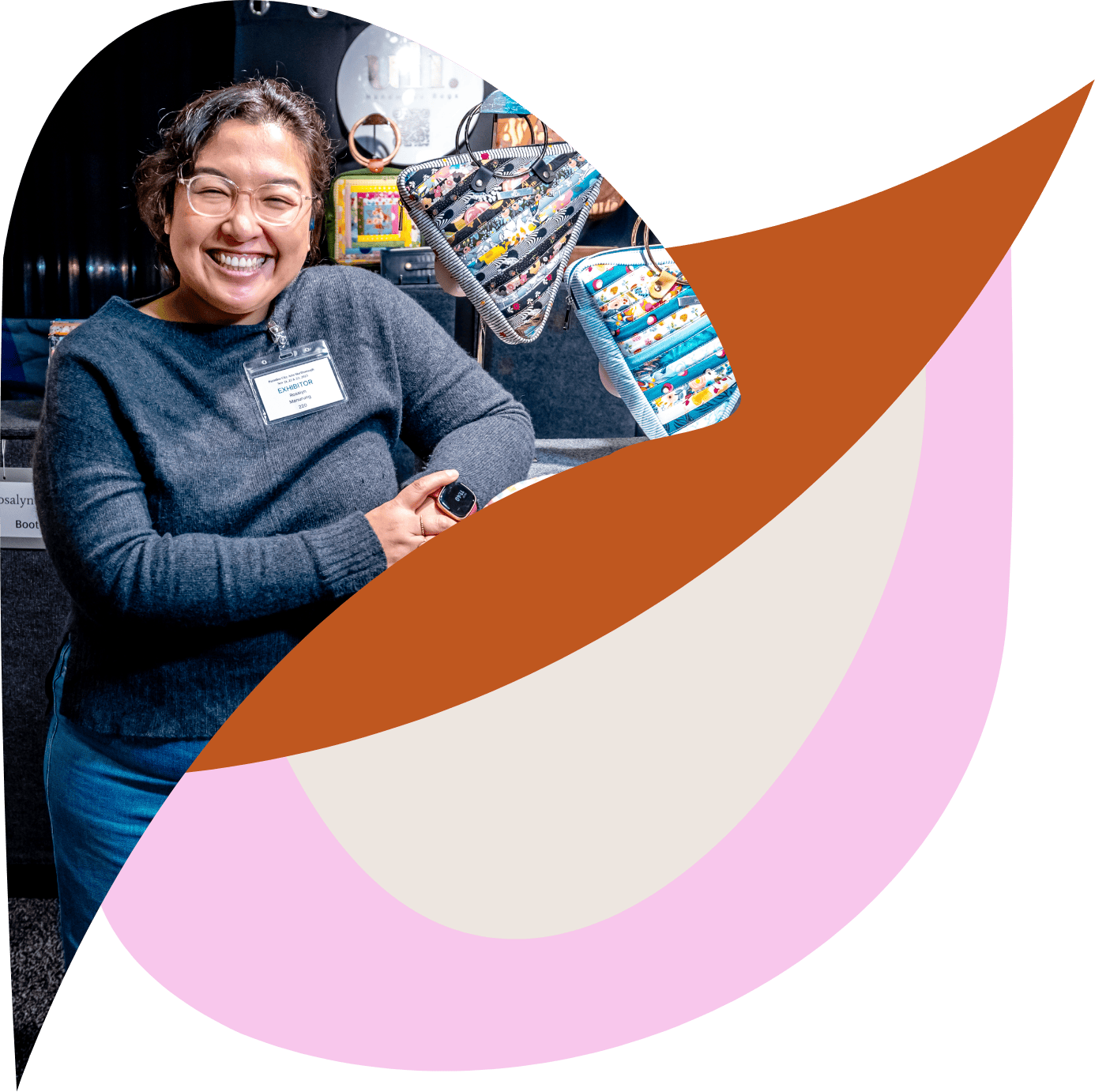

Thank you so much for hosting us in your creative space! How did this studio come to be, in your home on Hope Street?
I got this house in 2018, just before Covid hit. It was condemned. There had been no one living in it for nine years. When I came up to the house, it had a momma raccoon coming out of the side door with a baby raccoon, and I was like “this feels like home! This is the right place.” The raccoons couldn't stay, but it became a really cool adventure into figuring out how to build an entire space. So it's a three apartment house. And there's two other people that live here, and I have my studio in the basement.
I went to Smith College, and I always wanted to do art. That's been my fixation for a long time, and I felt like getting a more well-rounded education was something I was more interested in. Smith provided me with art history references, but also sociological studies, and anthropology. It taught me how to write, read, and study. Which I think really helped me in the long run.

There are so many pieces here we could talk about. Tell us about this painting in progress. What is the inspiration behind the colorful fish?
So on the easel behind me is a group of brook trout. I've been painting fish for so long. It's kind of a nod to living in a community. Motions of water and thinking about individuals versus what you are in relationship to larger forces. I was taking an advanced manufacturing class at Greenfield Community College with a bunch of guys who were deep in manufacturing, which is a world that is not like the art world. And a lot of the guys like fishing, and they were talking about the species of fish that are in the local springs around here. The brook trout is a really highly regarded native species, they are a sign that the ecosystem is doing really well. We are very lucky to have native brook trout that have been around for tens of thousands of years. They had this really interesting speckled, variegated patterning that happens on their skin in a really special way. It's cool to come back from the ocean themed work that I do, to look more locally at how the fish species in the water ecosystem are working around here.
I think I was always drawn to water. I think there are a lot of people that are drawn to water. It says that way back in the day, we crawled out of the ocean. It's a little four legged creature that took the land. And then we evolved from that state. And everything is born of water. Everything is born in a salt kind of embryonic fluid. It's a really good metaphor for the creative spirit, and the place where you're creating. And so that's sort of a nice little juicy place to chew on color and form. It feels like a spiritual conversation, and water helps me be less self-centered. (Normally) Investing in just myself. Thinking of just myself. Thinking of just my art. This topic makes me come out of that and think about the wider whole and how we're interconnected and how we're interrelated.

Are you a swimmer yourself?
Growing up in Texas we had a backyard pool. And so my parents decided, that's a great reason to join the swim team for ten years. And then we did diving. So I do a lot of scuba diving to look at the creatures up close and see how they're interacting. I go with my little GoPro and I'm nerding out on all the fish. But when I'm down there, I notice that if I'm struggling with something that's challenging– you know, like living– it suspends the rules, the same rules do not apply down there. And so there's something that's about mindful practice. Remember that you're a part of everything.
My color leans more into pointillism. So to me, breaking it down into dots is like speaking to atomic particles. There's a conversation going on between the brook trout and the stars in the universe. They go back and forth about vastness and specificity. And also the colored dots, I've gotten really into the dots because I've come into different ways of making pigments. So I'll use minerals, gemstone minerals to mix it with a certain kind of medium to make it into an acrylic paint. And I just want to revel in that specific color. So if something is turquoise, if something is a malachite, I will keep it as a dot to kind of love on that precious gemstone aspect of the color. I think that having the dots next to each other talks about relationships. Colors in relationship to one another change. And that's a really infinitely fascinating thing about painting to me– you could have a lifetime exploring color relationships. I think it also speaks to a relationship between people. Who are you in relationship to THIS? Who are you in relationship to THAT? What's a green in relationship to purple? What's a pink in relationship to red? And you can infinitely play there and think about things changing in relationship to other things.


In addition to your established career in painting, tell us how you started transitioning towards frames? How did you develop the process and what’s the inspiration behind them?
So I started making frames after I'd been doing resin layer painting for about 15 years. One of the things that kept digging at me is that there's a toxicity to resin. It does such beautiful things for color and glazing and it’s a nod to the traditional methods of glazing– pigments upon pigments– but the resin is not good for the environment, it's not good for water. So the frames have come about by thinking through my relationship to plastic resin as a medium. My frames are recycled plastic filament. I have invested nearly $10,000 into recycling things that break down plastic– extruded, heated to start creating frames and canvases out of the recycled plastic. I worked in tech for a few years and started working with CAD rendering software and how you can use it with 3D printing. So it became a way to marry recycled plastic with something more sculptural. And it could be a place where the paintings live. But it's also taking into consideration materiality. I love working with this resin medium, but what's the greater impact of it? How is the studio going to pivot with the understanding that I can't continue to be like this. Because it IS a problem.
There are different files available online to make ornate frames, but then you can use your phone to scan and make 3D images. So I will go to the woods a lot– walk with my pup– and I will take scans of things I find. I'll start scanning straw, flowers, dahlias, and from those make a steel file, which is like something that the 3D printer reads as an additive manufacturing file. You can make these individual files and start to compose them and piece them together, using an iPad and a program called Nomad Sculpt or Blender. There are ways one can also get imagery or find files online, from different museums (the Smithsonian or the Louvre) that have files like octopuses, or sea shells. I have sculptures that have taken images from the Louvre and incorporated them into the frames to be a little nod to the traditional baroque, or to moments in art history that I really love and that my work stems from and incorporate them into these lightweight, recycled plastic little entities.


One of the main things about using resin and thinking about recycled plastic is I love the ocean. I am diving and pulling out plastic from the reef systems. I'm complicit in my resin use, complicit to some of the toxic components that I'm finding and are killing the reefs. And so this project feels essential to me. How can we pull some of that plastic back and bring it back into the fine art medium? So it's not showing up as much in the studio currently, but what is happening in the background is a lot of shredding plastic and dotting it to make paintings and seeing what that will become.
I'm hoping that someday I can bring that to Paradise City Arts, as a new medium and something to teach, something to share with people more widely than just out of my garage studio.
Meet Scout in-person and discover her work at our Northampton Fall Festival, October 9-11 2026. Booth 904