You have such a haven here— what a magical spot for a woodland studio. Tell us about where we are, and how you chose this spot.
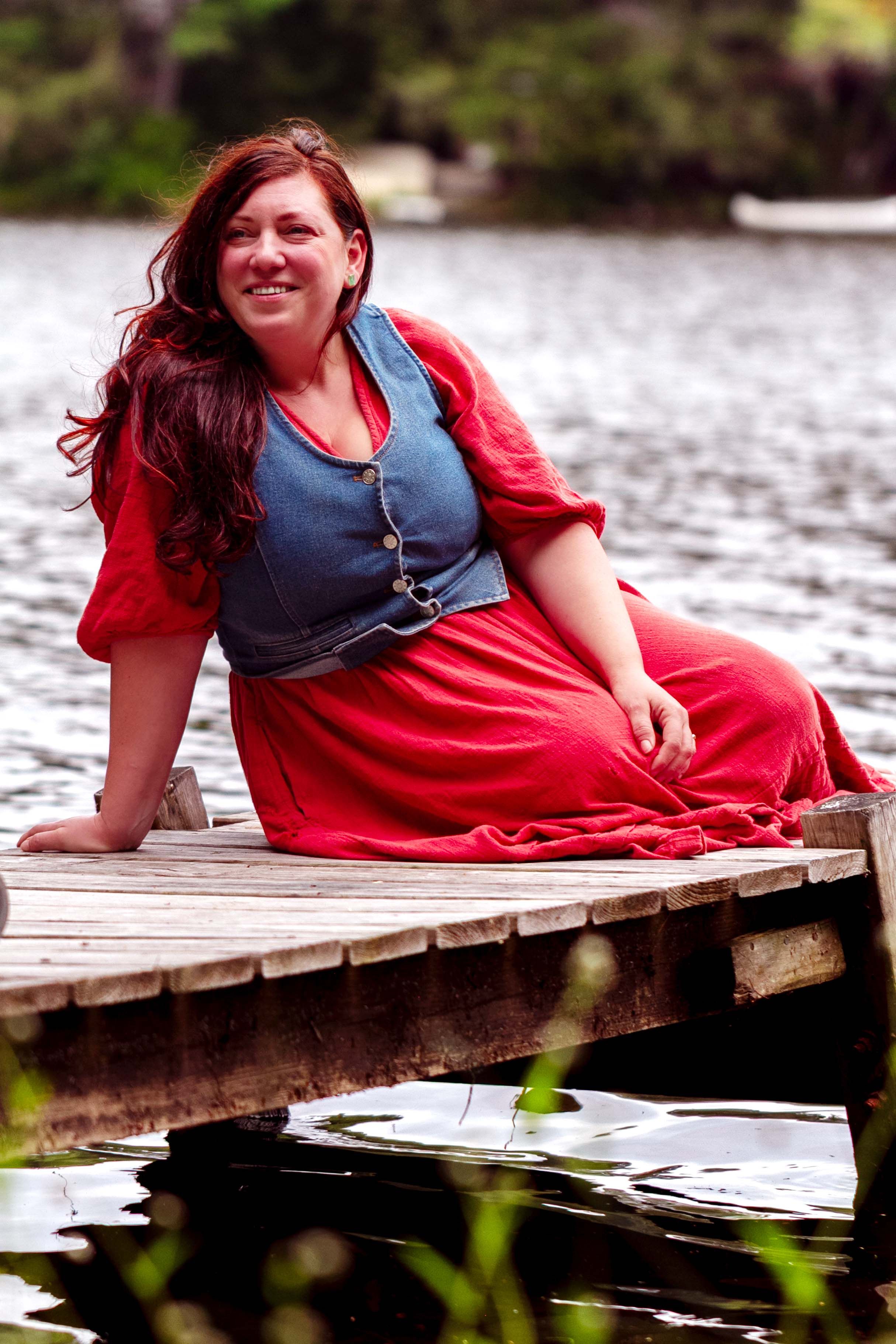
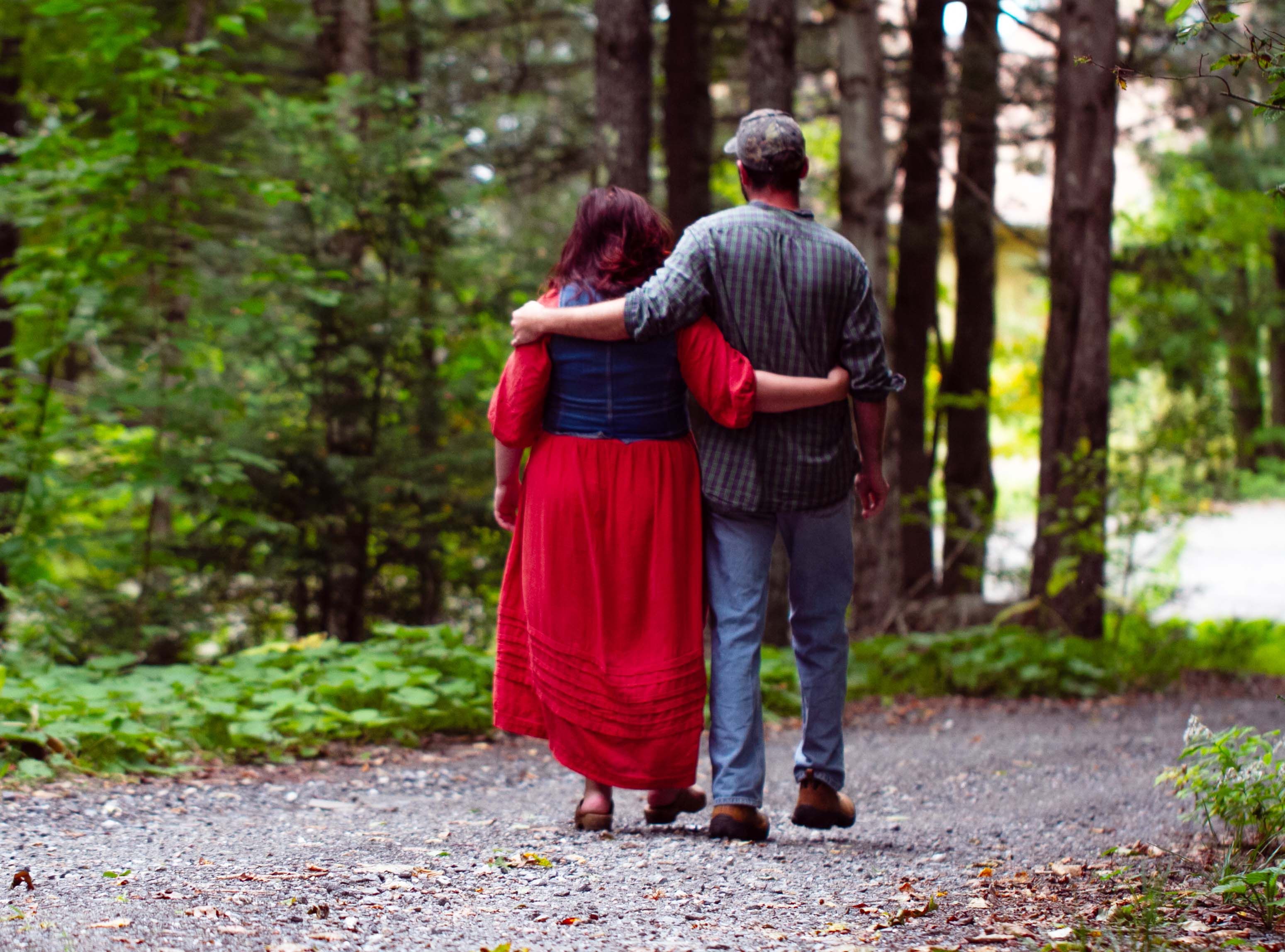
We are at my studio in Goshen, MA, and it's a little beautiful, tiny spot right here on my property where I live with my husband, Rob, and our two ridiculous dogs, Dolly Parton and Levon Helm, as well as our two ridiculous cats, Gus and Tova. This space used to be my dad's home. We built him a tiny house on our property after my mom passed away. So he lived here for the last six years of his life. He always wanted this to become my ceramic studio when he passed on, and so we held true to that wish, and it has a lot of bittersweet beauty because of that. I think it's really nice to be able to have this not become just a place that accumulates all of the things that I have, but rather a place where I can create.


The name Goshen Ocean, comes from all Goshen-ites, as we call ourselves. We are on Hammond Pond. Which is a really beautiful, little pond community. Most people don't live here year round. We're one of maybe 15 people that are here all year round. But in the height of the season, it's more like 200 people are here, but rarely all at the same time. It's pretty quiet.
So I started my ceramic practice seriously here. Even though I've been toiling with ceramics since I was in high school. When I was trying to think of what I wanted to call my ceramics and my own business, and thinking of a potters mark, what do I want call this? Well, everything's made right here in the Goshen Ocean. And that feels really good to say. I've never had a bad time here. You know, it's just full of joy!
Is there something from this natural environment that has influenced you and comes through in your work?
I hope it's that sense of familiarity, nostalgia, and comfort that is seen and felt through my work. I also feel for me, ceramics and functional ceramics are such a tactile experience— it’s meant to be held. You can put it on the wall and admire it like painting if you want, and you should also be able to feel the weight and texture of it in your hand. I think that in this space I do a lot of that, whether it's the moss in the forest or the velvety like texture of the water at night. There are things about that inhabiting this space for me.


How did you come to ceramics as your primary medium?
My background is in visual arts and illustration. Definitely my first and forever love will be painting. So I did a lot of oil painting— I did really large scale, more on the realist side, portraiture. I actually did a show called A Brief Enlightenment, and it was portraits of all my friends that were artists and musicians in the area, and I painted them like saints. Then I got it out of my system a little bit and thought, I need something else. Then I did a lot of woodblock printmaking— it’s the carving and the actual carving into the block that I love so much. The printing was fine— I like being able to make multiples, but it wasn't the reason I was doing it, it was more the tactile feeling of carving. I would say those are the skills that I've honed over my years of making art that are directly influencing my practice now.


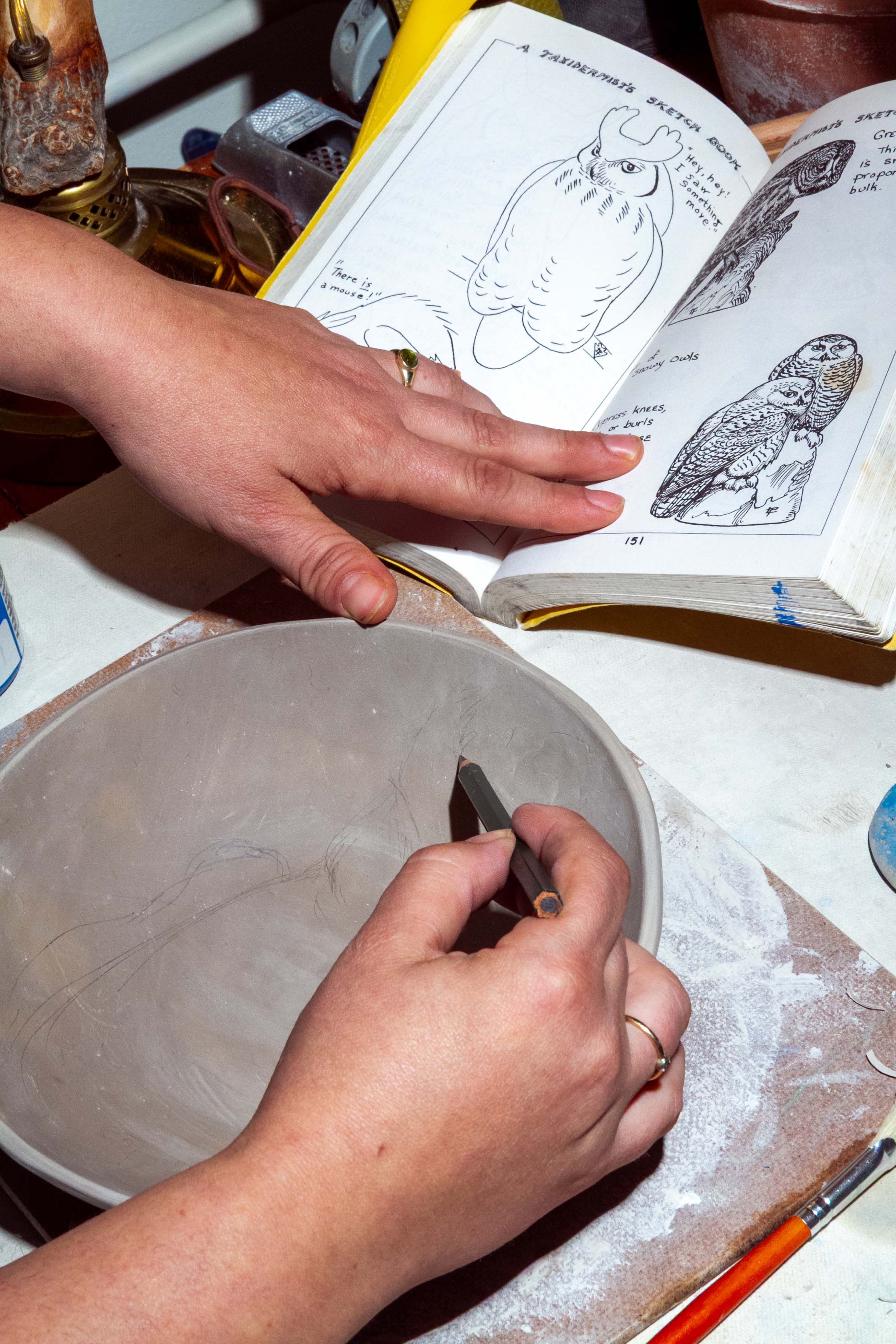
Coming up with the imagery, sketching that imagery out onto bone dry or leather hard clay. It's basically a process of engraving and wiping away. So it's very meditative, but it's also very detail oriented, versus sgraffito, which is like woodblock carving. And I'm still sketching out that design and figuring out how it's going to interact with the form, which is also really fun because I like having it feel like there's a certain amount of movement and fluidity to all of them, but also something that feels familiar. Those planning stages are so satisfying with sgraffito, especially if you're doing it in just the right stage of leather hard.
There's like nothing like carving out that clay when it's like hard butter. I could just do that forever, right? And those little fine details where you're like, Oh yes—Perfect!
I like to lean into the organic shapes that are a part of hand building especially. Most of my work is hand-built. I love letting the clay warp a little bit and do its thing, and then make an illustration that goes with that shape, that the clay naturally decided and was completely out of my hands. So I like figuring that out, but that can also be a challenge. There's a part of my brain that thinks, no must be symmetrical, must be the perfect circle. But it doesn't want to be. And maybe it's a little more interesting when it's not. I think in pottery, a lot of people have a preconceived notion of what it should look like or how it should feel. For me, it's more important for it to be stable. I want it to be light, generally. Even leaning into that asymmetrical nature of clay is something that's counterintuitive, but ultimately fun, even if it's a little challenging.


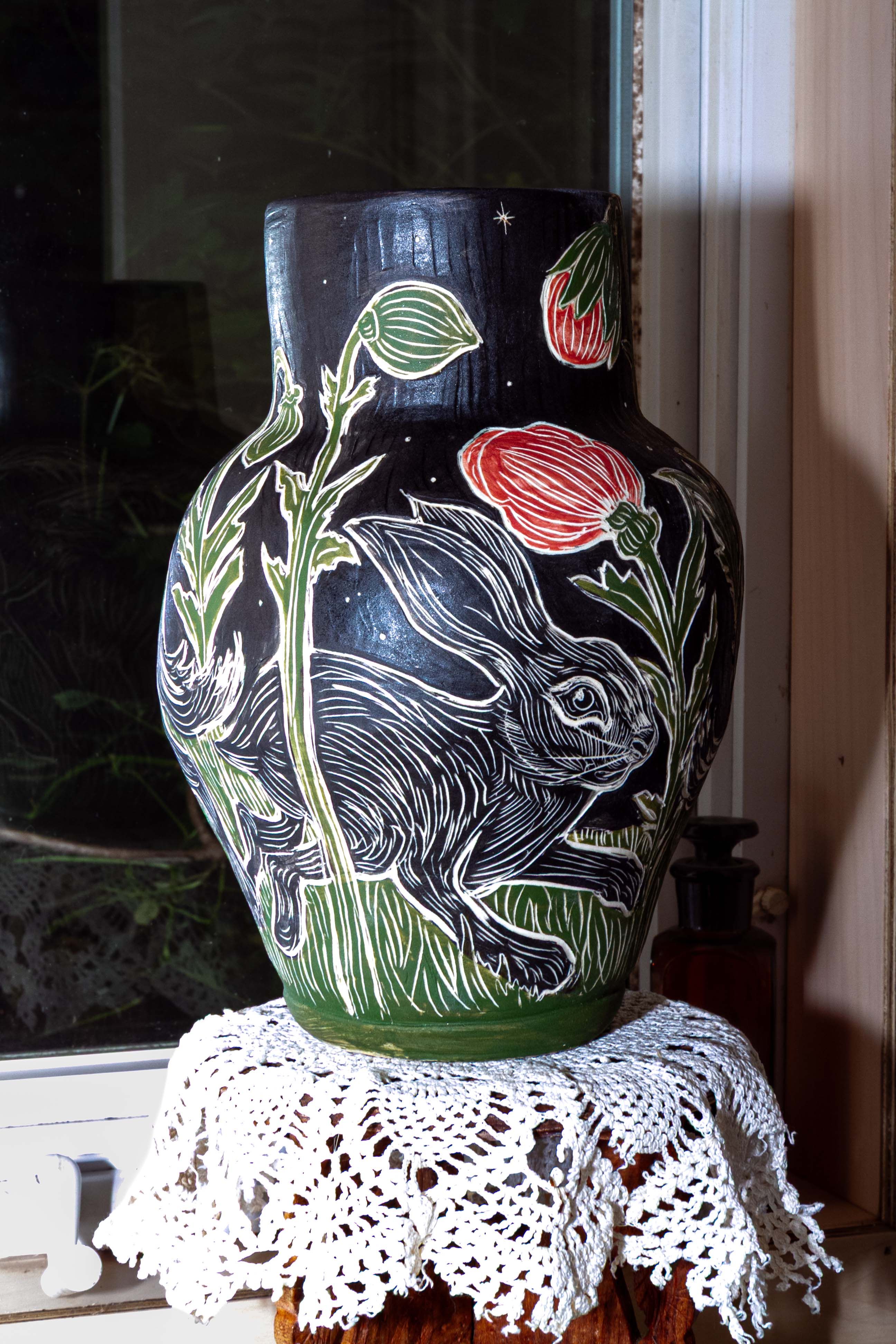
I would say with mugs and tumblers, glasses, things that are Drink Shop, are great things that are going to be used hopefully daily. So really thinking about what am I going to use, what image can I use to have wrap around completely. I do a certain amount of things that aren't Western Mass affiliated— like people love octopus. They're amazing to draw. I love them, they're so darling. We have whales on our coast, but they aren't really something I see on a daily basis. It's pretty much a creature that is roaming around this property. We have so many rabbits. That imagery of local nature. I really like that. And I think that it's also really important to not let it leave our minds that they're sharing all of this space with us, and how important our ecosystems are. Flora and fauna as well. I love local pollinators and different plants that are important to the health of beautiful valley that we have here. Having that be something that's infused, even if I'm not always pronouncing it.


So the way that I choose color palette, it's dependent on imagery. I have always been drawn to blue and white, I think because it is so timeless across ceramics in general. Whether you're looking at ancient Chinese pottery or Japanese pottery, Greek pottery, they all share this history of this cobalt and white. Even if you look at the most delicate porcelain from the Victorian era. It's this thing that I like to tap into— familiarity. Into nostalgia. When you look at something, maybe the imagery isn't necessarily that classical, but the colors are. Something that is new yet familiar, or something that is comforting, but then maybe also like gives you a little bit of a push and pull because you aren't so used to it. I think blue and white just looks beautiful with everything. I've been doing a little bit more black and white, that’s also timeless. It also is very much like woodblock print making. Where it's just that monochromatic color spectrum. So I like to play with that, but then add bursts of color into it.
One of your new collections is getting a glowing reception— can you tell us about your lamps?
So my husband is an amazing carpenter, he built this space, and he's been making lamps for over a decade. He does all the wiring, to make sure it's super safe. I'll be really particular about the cords that we're choosing. And then he finds all of these different pieces of wood. A lot of times from walking through our forests, a lot of the pieces are local. Although we've traveled cross-country and there have been forests and places where it's okay to take materials like that. It's already been cured by nature. Then taking that and making sure that nothing's living in it and it's ready to go. He'll seal them, a lot of times using some beeswax or a soft polyurethane. We’re letting an organic form dictate what imagery to put on it. I think a lot of the process with designing the lamps is also saying which way does that branch wants to go? I think of like an ikebana flower arrangement. It's letting the organic, asymmetry of a piece do the hard work. And then you sort of figure out how to play with that. Then he does a lot of really beautiful things— taking old wine bottles and cutting or frosting them. We have the old white & blue wine bottle on the inside. And then I make the ceramic form that sits on that, and it diffuses the glass a little bit, and makes the light quality slightly different.
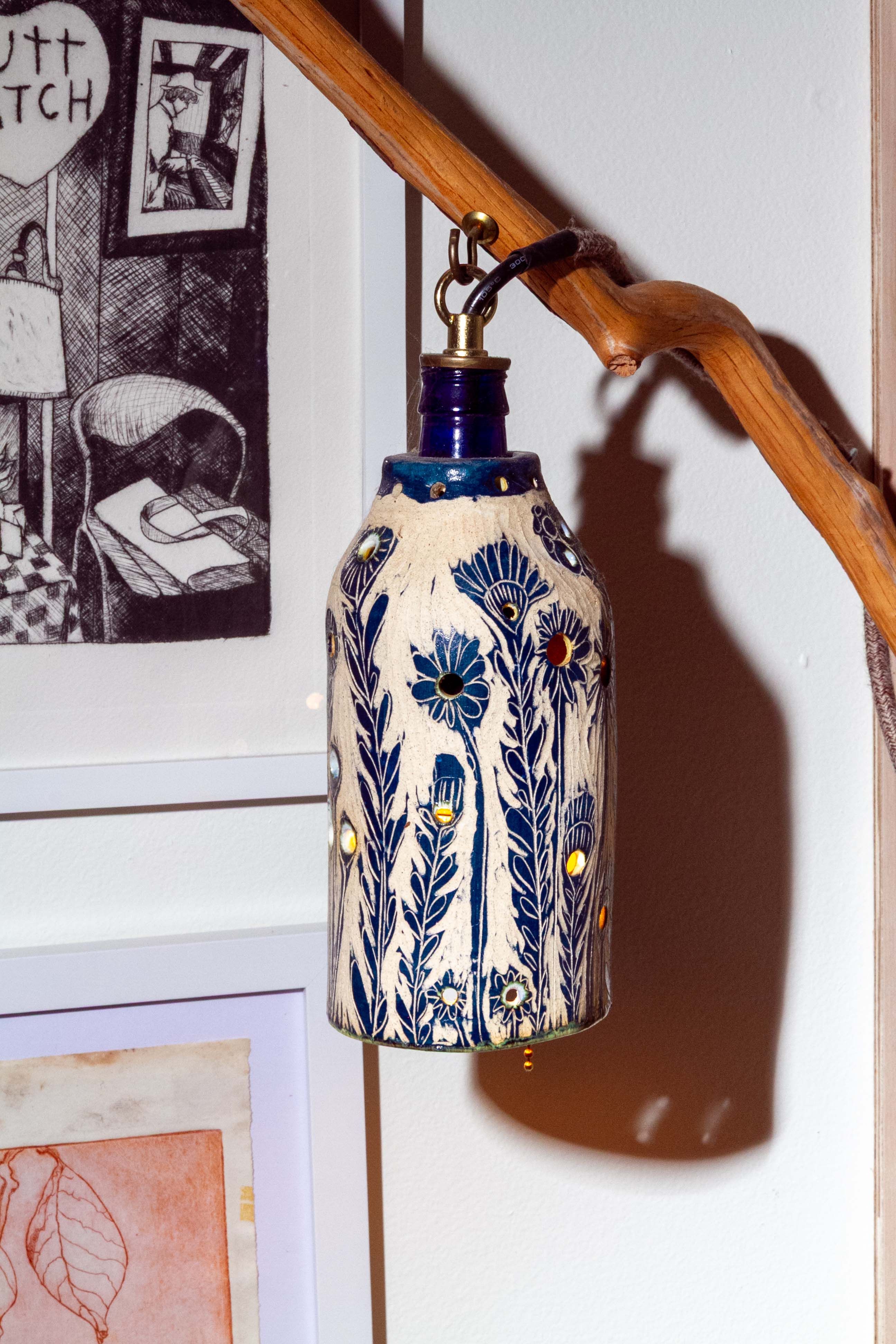
So it's this fun interaction of natural pieces of wood and then recycled elements from our daily human life— because you got to have a nice bottle of wine once in a while! Then the ceramic form complements whatever that is. It's been a really lovely collaboration. I'm really looking forward to building on that, because it's nice to have a partner that you can be creative with. On a lot of different levels, but have it be something so separate— I'm not about to build a lamp, but I'd love to make a lampshade! It's a nice thing to look forward to growing, for sure…
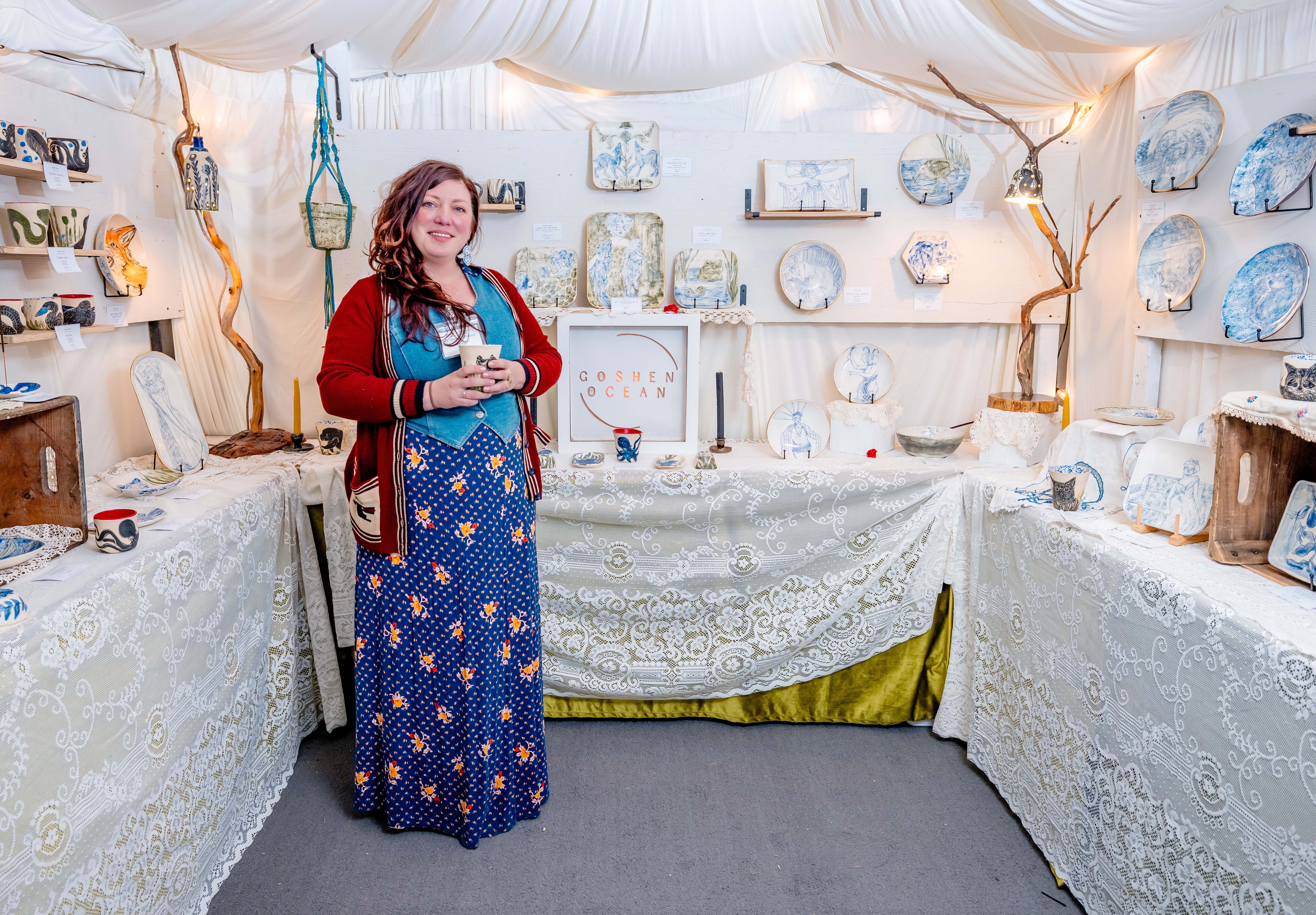
Meet Vanessa in-person and collect her work at the Paradise City Arts Fall Festival in Northampton, MA October 9-11, 2026. Booth #110